
Jyoti Punwani writes on human rights issues. You can e-mail the author at jyoti.punwani@gmail.com
'Those who attacked me, punish them.'

'The Quran says that saving one life is like saving humanity. So by donating for Kerala, you are following what Allah told you.' 'This gesture would create goodwill for Muslims and would work as a counter to the hostility they face.' Jyoti Punwani reports how some Muslims won't sacrifice goats this Bakri Eid, instead donating the money towards relief efforts in Kerala.
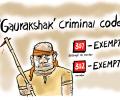
'What will work is not fear of the law, but of real and swift prosecution under the law.' 'That can now be a possibility thanks to the Supreme Court judgment.'

'This minority government will be for only 15 days.' 'By that time, its motion of confidence will be defeated, and it will have to resign.' 'Therefore, the swearing-in is a waste of money, energy and time.'
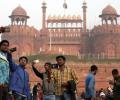
'How can the monument where the prime minister unfurls the flag on Independence Day, in a ceremony broadcast and telecast nationally, be maintained by a private entity?' asks Jyoti Punwani.

'So you wonder, couldn't he have combined these two qualities: His love of his own voice, and his acting talents, to voice concern about the Kathua and Unnao rapes?' asks Jyoti Punwani. 'His supporters are siding with the accused in the first case, and are the accused in the second.'
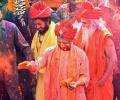
'In Yogi's Raj, Hindu festivals are State festivals.' 'He celebrates them, so does his police force, as he boasted in the assembly on Tuesday.' 'Eid, Christmas -- these can be observed, but expect nothing from the State to facilitate these celebrations,' says Jyoti Punwani.
Tensions continue to rise at IIT Indore over apology letters and quality of food.

'If Modiji likes his pakodas fresh from the pakodewala, why does his government keep making things difficult for us?'

'This is a public institution, run on public money and our fees,' the students say. 'Yet, decisions that affect us crucially are being taken without consulting us.'

'If ever there was a decisive moment in the history of the Supreme Court where it has been under attack by the Executive, and the judges have boldly stood up for independence of the Judiciary, that time was now.' 'These four judges did a brilliant thing, they set an example.' 'They showed that they were fulfilling their duty to the Constitution and to God.' 'Don't allow fear to dictate your actions was their message.'

'When you start delving deeper into these disappearances, you have to face the question: Was it a policy at the State level?' 'It surely couldn't have been random officers acting on their own.' 'Was it planned? What does it mean if the State allows its police to become lawless and act with impunity?' 'Perhaps the NHRC, for the 21 years that it has been seized of the matter, avoided these questions.'

In Nagpur Central Jail's 'Anda Cell' languishes a 90% disabled, ailing, professor, sentenced to life imprisonment for Maoist links.

'It is obvious that the lakhs who come to see it do not see it through the prism of religion,' says Jyoti Punwani.

'The forces of good are on the run.' 'But dark times also challenge people to fight.' 'I believe Indians will rise against these dark times.'

Mumbai Marathi Patrakar Sangh refuses to 'retreat in the face of threats'.

'When Irshad Khan approaches the Supreme Court, he will undoubtedly have the best and most committed of lawyers to represent him.' His case will be reported on the front pages.' Neither the BJP government in Rajasthan nor at the Centre can stop this,' says Jyoti Punwani.

'Mumbai's killings in January 1993 came at the tail end of two outbursts of vicious communal violence, whereas today, it's peacetime in a 'new India'.' 'At that time, the perpetrators warned onlookers to keep their mouths shut.' 'Today, the perpetrators take videos of their attacks, such is their confidence.' 'The mobs have succeeded in terrorising an entire community and indeed, all those dealing in the transport of cattle, whatever their religion,' says Jyoti Punwani.
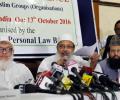
When the Muslim Personal Law Board promises 'advisories' and nikahnamas to the Supreme Court, one has to remember not only its recent campaign against any change in Muslim personal law, but also its past record of inaction on the question of triple talaq, says Jyoti Punwani.
'The cow is sacred to many of us, but these killings are definitely not part of the Hinduism we know and practise,' says Jyoti Punwani.
